

[Mar 17, 2026] 300-420 Free Exam Questions with Quality Guaranteed
300-420 Free Exam Files Downloaded Instantly
To prepare for the Cisco 300-420 exam, candidates can take advantage of the various resources provided by Cisco, such as online training courses, study guides, and practice exams. Hands-on experience with Cisco products is also an essential part of the preparation process. Passing the exam requires a score of at least 750 out of 1000, and the certification is valid for three years. Overall, the Cisco 300-420 certification is an excellent way for network engineers to demonstrate their expertise in designing complex enterprise networks and enhance their career prospects in the industry.
NEW QUESTION # 13
Which Cisco product were incorporated into Cisco ISE between ISE releases 2.0 and 2.3?
- A. Cisco ESA
- B. Cisco ACS
- C. Cisco ASA
- D. Cisco WSA
Answer: B
NEW QUESTION # 14
Drag and drop the components in a Cisco SD-Access architecture from the left onto their descriptions on the right.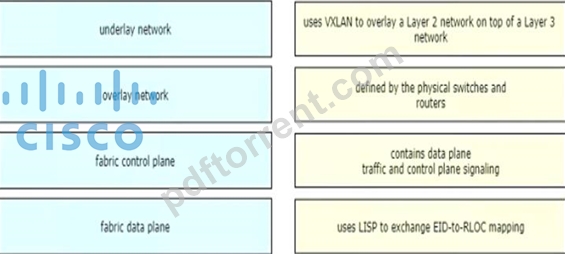
Answer:
Explanation: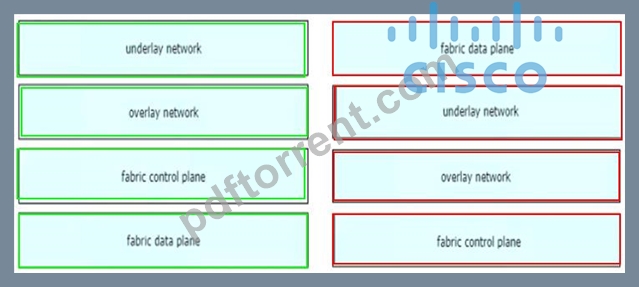
NEW QUESTION # 15
In an SD-WAN architecture, which methods are used to bootstrap a vEdge router?
- A. vManage or DNS records
- B. DHCP options or manual configuration
- C. DNS records or DHCP options
- D. ZTP or manual configuration
Answer: D
Explanation:
Section: WAN for Enterprise Networks
NEW QUESTION # 16
Which two best practices must be followed when designing an out-of-band management network? (Choose two.)
- A. Facilitate network integration
- B. Ensure network isolation
- C. Enforce access control
- D. Back up data using the management network
- E. Ensure that the management network is a backup to the data network
Answer: B,C
NEW QUESTION # 17
Drag and drop the components in a Cisco SD-Access architecture from the left onto their descriptions on the right.
Answer:
Explanation: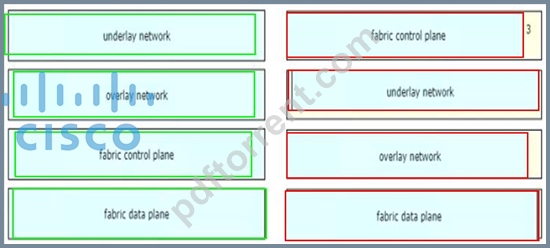
NEW QUESTION # 18
An engineer is designing an enterprise campus network.
The LAN infrastructure consists of switches from multiple vendors, and Spanning Tree must be used as a Layer 2 loop prevention mechanism.
All configured VLANs must be grouped in two SIP instances.
Which standards-based Spanning Tree technology supports this design solution?
- A. RSTP
- B. STP
- C. Rapid PVST
- D. MSTP
Answer: D
NEW QUESTION # 19
When designing interdomain multicast, which two protocols are deployed to achieve communication between multicast sources and receivers? (Choose two.)
- A. MP-BGP
- B. BIDIR-PIM
- C. IGMPv2
- D. MLD
- E. MSDP
Answer: A,E
Explanation:
MSDP (Multicast interdomain discovery protocol) should exchange routing information using BGP.
NEW QUESTION # 20
Which two options are requirements for EIGRP authentication? (Choose two)
- A. The authentication key IDs must match between two neighbors.
- B. The Authentication key must be configured under the interface running EIGRP.
- C. AN IPsec profile must be configured.
- D. The authentication key must be configured within the EIGRP routing configuration.
- E. A separate key chain must be configured.
- F. A crypto map must be configured.
Answer: A,B
NEW QUESTION # 21
Which feature minimizes TLOC connections and reduces strain on the vSmart controller in an SD-WAN architecture?
- A. affinity
- B. control-direction
- C. color
- D. control-connections
Answer: A
NEW QUESTION # 22
Refer to the exhibit. Which solution decreases the EIGRP convergence time?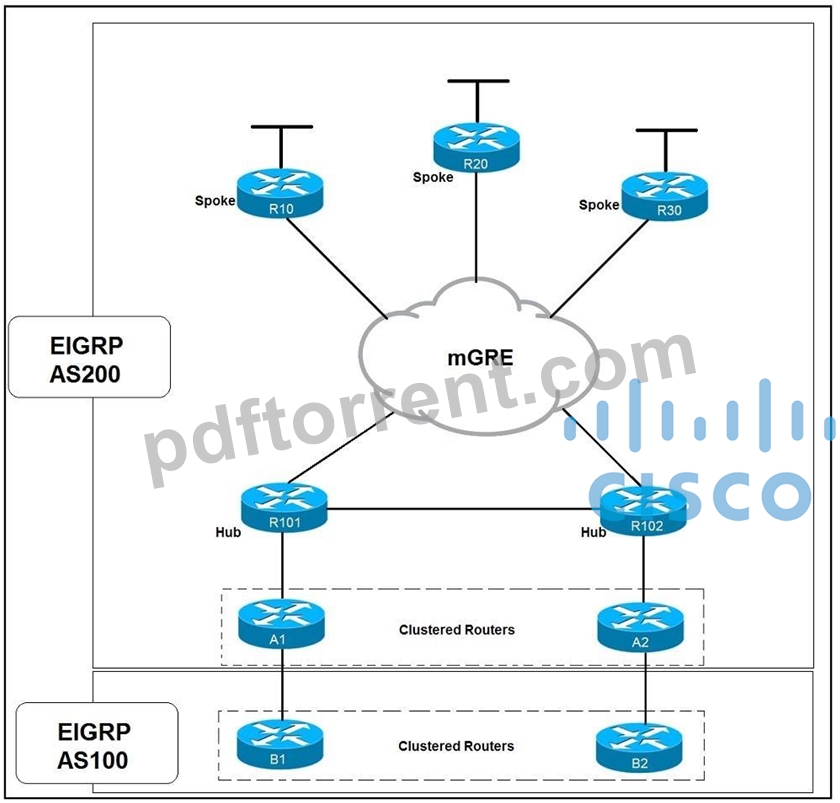
- A. Enable subsecond timers
- B. Increase the dead timer value
- C. Increase the hold time value
- D. Enable stub routing on the spokes
Answer: D
Explanation:
Query storms are eliminated, which saves bandwidth and CPU and allows the network to converge more quickly.
https://www.cisco.com/en/US/technologies/tk648/tk365/technologies_white_paper0900aecd8023 df6f.html
NEW QUESTION # 23
An engineer must design a QoS solution for a customer that is connected to an ISP over a 1Gbps link with a 100Mbps CIR. The ISP aggressively drops all traffic received over which is causing numerous TCP retransmissions. The customer is not using any RTP applications but wants to maximize bandwidth usage up to the CIR. Which QoS solution engineer choose?
- A. Policing
- B. Traffic shaping
- C. Queuing
- D. Policer with markdown
Answer: B
Explanation:
https://www.cisco.com/c/en/us/support/docs/quality-of-service-qos/qos-policing/19645- policevsshape.html
NEW QUESTION # 24
Refer to the exhibit.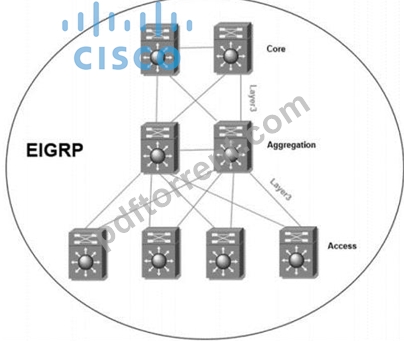
Refer to the exhibit. The full EIGRP routing table is advertised throughout the network. Currently, users experience data loss when any one link in the network fails. An architect optimizes the network to reduce the impact when a link fails. Which solution should the architect include in the design?
- A. Run BFD on the inter links between EIGRP neighbors.
- B. Summarize the access layer networks from the aggregation layer toward the core layer.
- C. Reduce the default EIGRP hello interval and hold time.
- D. Summarize the access layer networks from each access layer switch toward the aggregation layer.
Answer: A
NEW QUESTION # 25
A client is moving to Model-Driven Telemetry and requires periodic updates.
What must the network architect consider with this design?
- A. The primary push update is sent immediately and cannot be delayed.
- B. Periodic updates include a full copy of the data that is subscribed to.
- C. Empty data subscriptions do not generate empty update notifications.
- D. Updates that contain changes within the data are sent only when changes occur.
Answer: D
NEW QUESTION # 26
In a cisco SD-Access brownfield deployment scenario, which configuration deployment must be taken with Cisco DNA center?
- A. Automated UNDERLAY
- B. Manual underlay
- C. Subnet stretching
- D. LAN automation
Answer: B
Explanation:
In a brownfield deployment scenario, the deployment of the underlay network must be taken with manual configuration. The other configurations, such as subnet stretching, LAN automation, and automated underlay, can be done with the help of Cisco DNA Center.
NEW QUESTION # 27
Refer to the exhibit.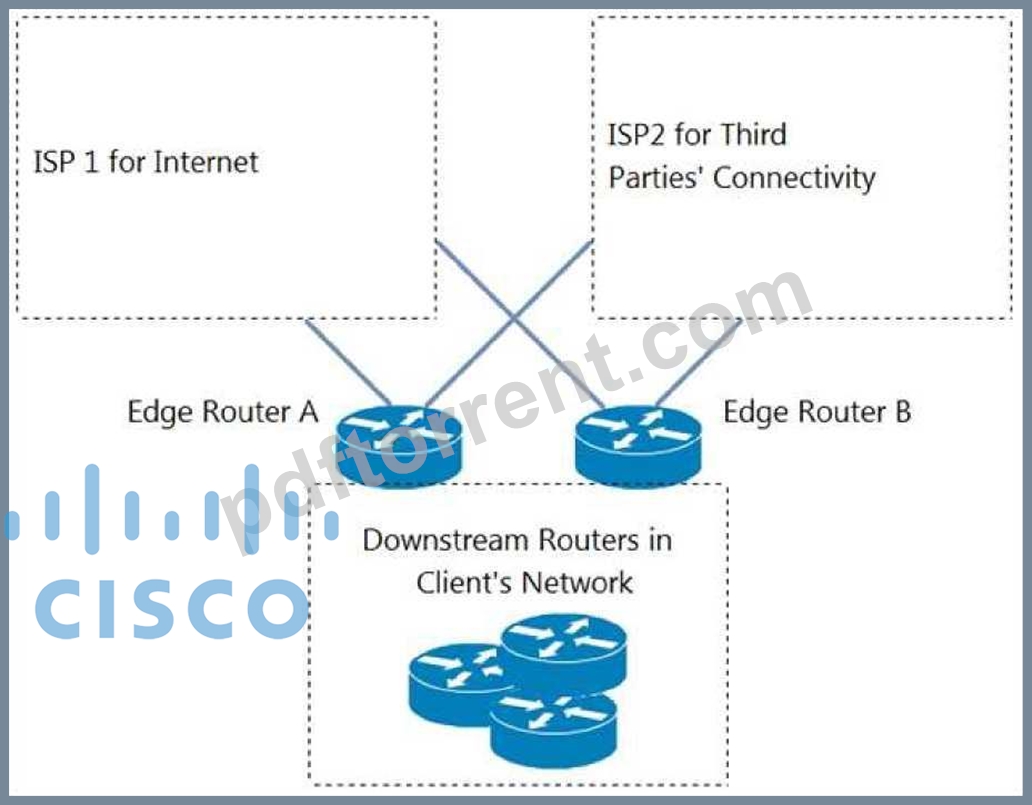
Refer to the exhibit. An engineer is designing a BGP solution for a client that peers with ISP1 for full Internet connectivity and with ISP2 for direct exchange of routes for several third parties. Which action, when implemented on the edge routers, enables the client network to reach the Internet through ISP1?
- A. Advertise a default route for downstream routers within the client network.
- B. Run an eBGP session within different VRFs for each ISP.
- C. Apply the AS-path prepend feature for ISP2.
- D. Apply route filtering such that the client advertises only routes originated from its own AS.
Answer: A
NEW QUESTION # 28
A network administrator is troubleshooting a DMVPN setup between the hub and the spoke.
Which action should the administrator take before troubleshooting the IPsec configuration?
- A. Verify the GRE tunnels.
- B. Verify NHRP.
- C. Verify crypto maps.
- D. Verify ISAKMP.
Answer: A
NEW QUESTION # 29
What is a feature of the SaaS subscription model?
- A. lower initial costs
- B. autonomy and control over hardware
- C. web connection not required
- D. access to industrial-strength storage and computing power
Answer: A
NEW QUESTION # 30
Refer to the exhibit.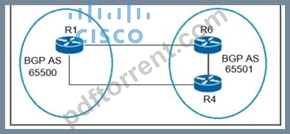
Refer to the exhibit. An architect must design a solution to connect the two ASs. To optimize bandwidth, the design will implement load sharing between router R6 and router R4. Which solution should the design include?
- A. Configure the eBGP TTL to support eBGP multihop.
- B. Use maximum-paths to install multiple paths in the routing table.
- C. Use next-hop-serf attributes only for routes that are learned from eBGP peers.
- D. Use update-source to specify the Loopback interface.
Answer: B
NEW QUESTION # 31
A network engineer must segregate three interconnected campus networks using IS-IS routing. A two-layer hierarchy must be used to support large routing domains and to avoid more specific routes from each campus network being advertised to other campus network routers automatically. Which two actions does the engineer take to accomplish this segregation? (Choose two.)
- A. Designate two IS-IS routers from each campus to act as Level 1/Level 2 backbone routers at the edge of each campus network.
- B. Assign the same IS-IS NET value for each campus, and configure internal campus routers with Level 1/ Level 2 routing.
- C. Utilize different MTU values for each campus network segment. Level 2 backbone routers must utilize a larger MTU size of 9216.
- D. Designate two IS-IS routers as BDR routers at the edge of each campus, and configure one BDR for all Level 1 routers and one BDR for all Level 2 routers.
- E. Assign a unique IS-IS NET value for each campus, and configure internal campus routers with Level 1 routing.
Answer: A,E
Explanation:
Section: Advanced Enterprise Campus Networks
NEW QUESTION # 32
Which topology within a network underlay eliminates the need for first hop redundancy protocols while improving fault tolerance, increasing resiliency, and simplifying the network?
- A. routed access topology
- B. virtualized topology
- C. Layer 2 topology
- D. logical fabric topology
Answer: A
Explanation:
In this solution, the access layer switches act as default gateways and participate in routing, and there is no need for an FHRP.
NEW QUESTION # 33
Which consideration must be made when designing a Cisco SD-Access fabric underlay?
- A. Subnets must be reduced to decrease latency.
- B. The default MTU should be increased.
- C. A unified policy must be used.
- D. Up to six control planes are supported.
Answer: B
Explanation:
Explanation
Look under "Underlay Network Design". Its the second bullet point.
https://www.cisco.com/c/en/us/td/docs/solutions/CVD/Campus/cisco-sda-design-guide.html#Underlay_Network
NEW QUESTION # 34
......
Q&As with Explanations Verified & Correct Answers: https://dumpstorrent.pdftorrent.com/300-420-latest-dumps.html